There is a 10 minute video essay published on youtube summarising mounts bay beach. The video covers some of the habitats and species which could be encountered as well as tourist attractions and facilities, and local businesses.
Follow this link to VIEW THE VIDEO
Tuesday, 21 April 2009

Wednesday, 15 April 2009
Marazion Marsh SSSI
This is the largest area of reed marsh in Cornwall. It is a SSSI as well as an RSPB protected area. The area is a really important area for native as well as migratory birds as a feeding area. The marsh is protected from the sea with the sand dunes on the beach at marazion.
The marsh is home to many different species of bird, both resident and migratory.
The marsh is home to many different species of bird, both resident and migratory.
Sand Dunes

Cornwall has 20km of dune frontage. In the 1997 Cornwall Biodiversity Audit dunes were identified as being under threat and so chosen as priority habitat for future action plans.
Current Sea Defences
 One of the strengths of the beach is its extensive sea defences. In the image above the rock armour used at the Chandour end of the beack is visible. These large lumps of rocks are strategically placed to minimise wave energy.
This closeup of the rock armour shows the gaps between the rocks which dissipates the wave energy.

Further along the beack towards Marazion there is a gap in the rock armour where a river enters the sea. In the image above you can see strong metal bars used to contain the rock armour on either side of the river.
The defences change along the length of the beach. Below you can see armour flex has been used. This has been laid over the original dune area however is less effective than the rock armour.

Here near the Marazion end of the beach there is a groin in place to hold snad out of the stream entering the beach. To the left of the groin is a clearly visible build up of sand.

Sandy Shore Species
 Oystercatchers have adapted beaks to find food in the sand. Here they thrive on the lugworms burrowing beneath the surface.
 Sea potatoes are a member of the cnidaria phylum with star fish and sea urchins. These species use their firm bristles to burrow deep in the sand.
This is the top of a sand mason worms tube, under the surface the worm lives in its tube made from sand and mucus.

Rocky Shore Species
 This is an example of a community of limpets and mussels, along with some brown seaweed. The mussels clump together in mats on the rocks to act as one, with the wave energy going over them all instead of single mussels being torn from the rocks.
Under the water in this image, taken in the spring, dog whelk eggs are visible, the small cream rugby ball shapes on the left. To the right adult dog whelks are sheltering.

Here in the centre is a snakeslocks anenomie with bright green and purple nentacles. In the foreground is sea lettuce, a form of green algae.

In this tidal pool harpoon weed is starting to take over.
 The rocky areas on the beach are home to a wide range of species, in this image there are volcano barnacles, a smaller species of barnacle (to the left),red calcifying seaweed, red encrusting algae (under the water on the right) and bright orange breadcrumb sponge (in the centre).
Chyandour


Tidal changes at Chyandour. Here you can see the tidal range where the beach is totally submerged at high tide. There is a large area of the beach uncovered at low tide due to the low gradient of the beach. In rough weather waves can spread high up the rock armour, to the left of the image, it is also clear here where seaweed has covered the rock armour.
New studies are currently being carried out looking into rock armour and adapting it to encourage more wildlife to grow there, by using sand bags and gavel between the spaces of rocks it is hoped that it will encourage sedimentation creating habitats amongst the rock, increasing the biodiversity.

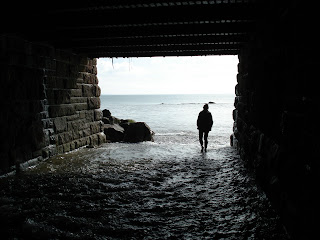
Here at Chyandour looking through one of the three tunnels at high and low tide it is possible to see the rocks which in spring tides or rougher conditions are impossible to see. These rocky formations house a variety of marine species with mussels being the most common species.
New studies are currently being carried out looking into rock armour and adapting it to encourage more wildlife to grow there, by using sand bags and gavel between the spaces of rocks it is hoped that it will encourage sedimentation creating habitats amongst the rock, increasing the biodiversity.


Here at Chyandour looking through one of the three tunnels at high and low tide it is possible to see the rocks which in spring tides or rougher conditions are impossible to see. These rocky formations house a variety of marine species with mussels being the most common species.
Subscribe to:
Posts (Atom)
